The Adopt an Adult Lake Sturgeon Store is now live! Click on the photo below to complete your lake sturgeon adoption today!
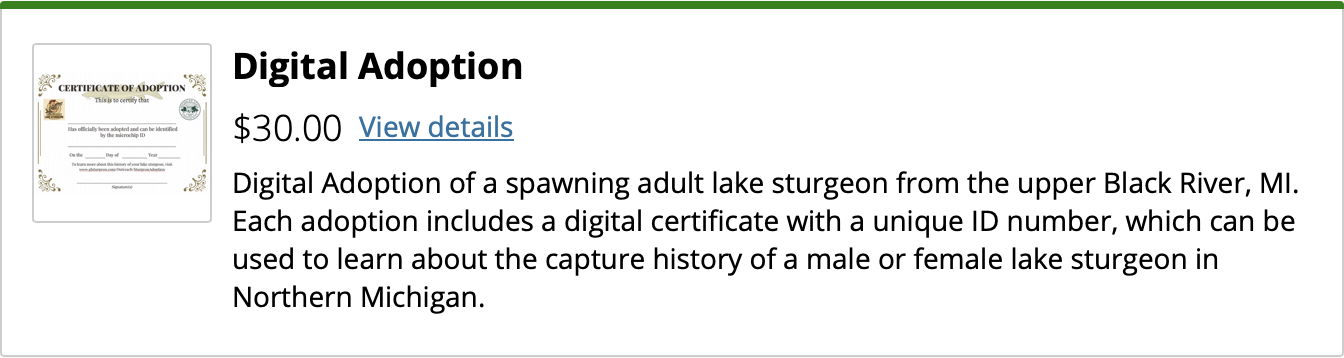
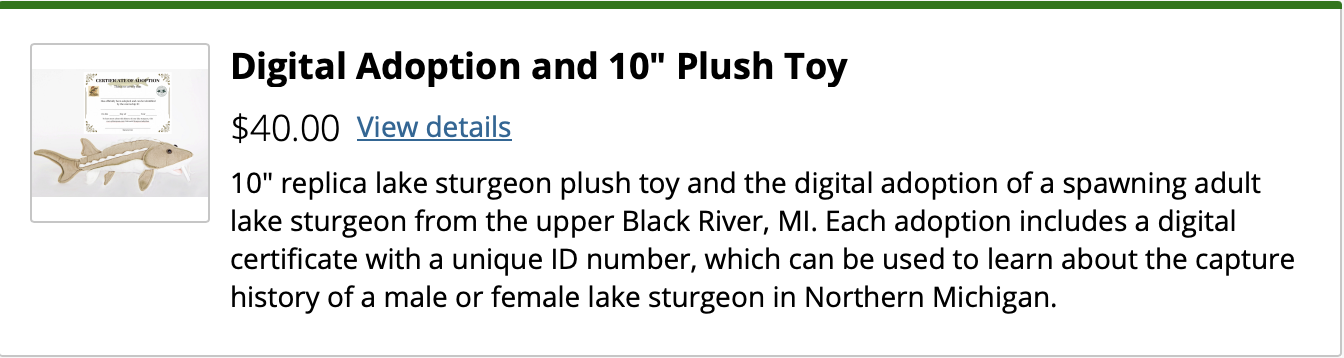
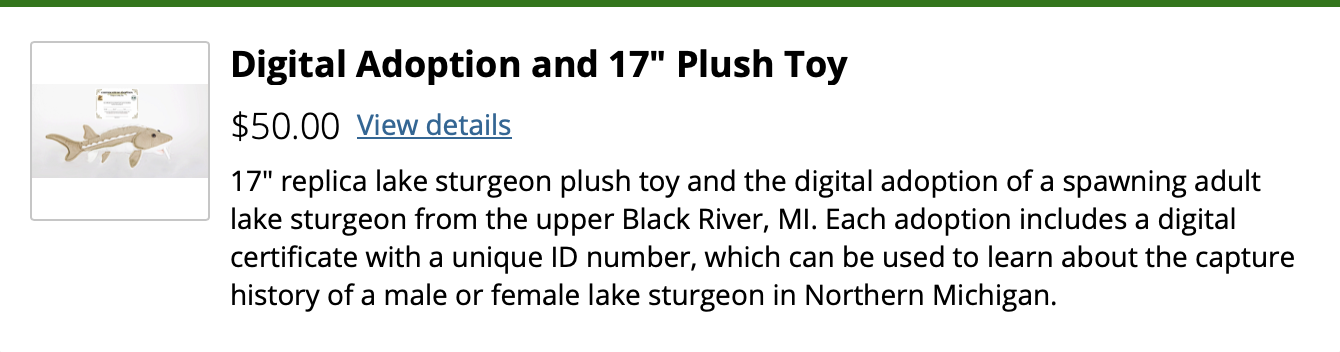

Enter the 9 or 15 digit ID number in the field below to learn more about the capture history of your lake sturgeon in the upper Black River!
Learn More about the Black Lake System!
Tag Types:
 RFID tag – Radio Frequency Identification – Read-only 134.2 kHz tags with a 64 bit unique ID, which presents as either 10 digits or 15 digits. This passive tag is injected into the pectoral fin, allowing the tag to remain close to the bottom of the river. Passive antenna stations are setup at the mouth of the river, entrance to the known spawning area, throughout the spawning area, and at Klieber Dam. Tags are detected and recorded when fish pass the antennas, and downloaded throughout the field season . Tag length is 32mm, diameter is 3.65 mm, and weighs 0.8g. Given the tag has no battery, so long as there is an antenna providing power, tags can operate indefinitely.

PIT tag – Passive Integrated Transponder – Read-only 134.2 kHz tags with a 64 bit unique ID, which presents as 15 digits. This passive tag is injected under the third dorsal scute on the top of the fish. To be read, a fish must be captured by a diver and physically scanned for a tag. PIT tags are used to uniquely identify each individual adult lake sturgeon which has been captured in the upper Black River since 2001. Prior to 2014, tags were 125 kHz alphanumeric tags, which have a much shorter detection range. If the tag looks similar to the microchip carried by your pet at home, that’s because it is! Both pet microchips and PIT tags are regulated by the International Committee for Animal Recording (ICAR) and International Standard Organization (ISO) to ensure that tag IDs are not duplicated, and can be traced back to the original tag purchaser!
 Acoustic Transmitter – COMING SOON! – A small, sealed device implanted in the fish’s body cavity that emits short sound pulses (“pings”) underwater. Each tag encodes a unique ID, so receivers can tell which individual fish produced a ping. Tags use ultrasonic sound (tens of kHz; e.g., ~60–80 kHz). Higher frequency ⇒ smaller antenna/transducer, but sound attenuates faster. Instead of a constant tone, the tag sends a coded sequence—often pulse-position or time-interval modulation—so a receiver can extract the fish’s ID (and sometimes sensor data like depth, temperature, or even if a fish is eaten!). Pings are transmitted at pseudo-random intervals (e.g., every 30–90 s). Randomization reduces “collisions” when many tags ping at once. Ultimately, Faster pinging gives finer movement data but drains the battery sooner. Smaller tags have less battery and lower source level (quieter). For more information about how fisheries researchers are collaborating to take movements of fish across the Great Lakes region, visit https://glatos.glos.us/